Facebook Twitter Google RSS
Showing posts with label Life Style. Show all posts

Thursday, 19 December 2013

Instructions on Using a Tanning Bed for the First Time


The first time you use a tanning bed can be a little intimidating, and well it should be. Lying in a tanning bed is no safer than lying out in the sun, and exposure to a tanning bed's UV rays can lead to skin cancer and premature aging of the skin. With that said, there are several things you can do to limit damage to your skin, including following these instructions on using a tanning bed for the first time.

When done safely, tanning is a gradual process. It is important that you start slowly and work your way up gradually, preferably tanning no more than a few times per week. The first time you use a tanning bed, you should go for no longer than a few minutes. You never know how your skin is going to react, and going for too long could lead to severe sunburn. Tanning-bed operators should be trained to help you determine how long you should tan for, but don't count on this. It's better to be safe than sorry, so go at your own slow and steady pace, even if this takes longer or costs a bit more.

Most people prefer to tan in the nude to prevent tan lines, but you should tan in whatever you feel most comfortable in. You might choose to cover up more sensitive areas with a towel or wear your swimsuit or underwear. Also, just because you're trying to get a tan doesn't mean you should leave the sunscreen at home. Using a mid-level SPF is a good way to help prevent sunburn and gradually build your tan.

Protective eyewear is also vitally important, something first-time tanners may not know. Some tanning salons have eyewear you can borrow, but these days most businesses require you to buy your own. Fortunately, these cost no more than a few dollars, and are well worth every penny, as the intense UV rays of a tanning bed can seriously damage your eyes if they are left unprotected. Simply shutting your eyes won't work, as the UV rays can travel through the thin skin of your eyelids.

Another issue with tanning beds is getting an even tan. If you always lie on your back, your back side is going to get more tan than your front, because of the closer contact to the bulbs. You should alternate lying on your front and back or occasionally use a stand-up bed to even out your tan.

The operation of most tanning beds is pretty self-explanatory once you've seen a bed or two, but first-time tanners might be overwhelmed by these often space-aged looking machines. If this is the case for you, don't be afraid to ask lots of questions. Tanning salon operators should take extra time with customers who are using a tanning bed for the first time, walking them through the process and explaining how to use the bed. If the salon is too busy and the attendant isn't ready to give you his or her full attention, you might want to come back at another time or try another salon.

If you follow these instructions the first time you use a tanning bed, you should feel more comfortable and be less prone to sunburn. Remember that the tanning salon attendant is there to help you and don't be afraid to ask questions if you're unsure of something.

Erase Those Dark Circles Under Your Eyes

 
Whether those dark circles under your eyes are caused by lack of sleep, lack of hydration or lack of hereditary luck, you can combat them with the same methods. You'll need to experiment with concealers, creams and formulas to find out what works best for you, but here are a few guidelines to get you started.

First, be sure to moisturize your under eye area-often the skin here can be dry and flaky. You can use a standard facial lotion or you could invest in a specially formulated cream in the hopes that it will benefit your dark circles. Any staffer at a beauty store or cosmetics counter can help you locate a cream for this problem, but you may want to look for ones that contain Vitamin K or a combination of Vitamin K and Vitamin A (Retinol)-studies have found these ingredients to be effective in minimizing dark circles over time. You might also want to prime your skin with a cream containing a hint of shimmer. Many undereye creams have this anyway, given that the sparkle will help reflect light and cause your undereye circles to appear lighter.

For a quick fix, cover up your raccoon eyes during your daily makeup routine. Apply a concealer to your undereyes before you apply foundation. You can't just use any concealer though: you should choose one that will counteract the color of your circles. A good rule is to use one that's a shade lighter than your foundation. If your under eye area has a blue or grey hue, select a yellow-based concealer; if the circles have a brownish appearance, go for a light blue or mauve-toned concealer. Even though you might think choosing a light or white-colored concealer would make your circles lighter, such a technique will draw attention to your undereyes.

Finally, remember that you can always create a diversion. Draw attention up and away from your undereyes-line the upper lash line only with a dark brown or black pencil. Then cover your eye lid with a shimmering eye shadow that'll brighten your face.

 http://www.life123.com/beauty/cosmetics/makeup/hiding-dark-undereye-circles.shtml

The science behind stuffing your face at Christmas

 Christmas dinner
Feeling full, psychology and how festive food and drink make a monster of your appetite
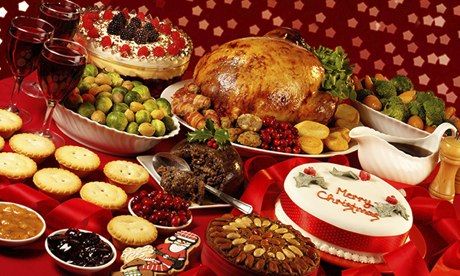
The amount of food we can put away on Christmas day is as impressive as it is excessive. Chocolates and mince pies are fair game 24/7. Savoury nibbles are needed shortly after breakfast, to soak up the mid-morning livener. And then, shockingly soon after lunch and all its trimmings, as soon as someone breaks out the pickled onions, I'm off again. And so it continues.
One reason we can keep putting it away like this is a phenomenon called sensory specific satiety (SSS). We can have enough of one sort of food, but still have an appetite for something else. It lies at the root of the expression "pudding stomach". It is why the trend for small sharing plates is a restaurateur's dream and a slimmer's nightmare. It is why kids suddenly declare: "I don't like it," while eating a food they definitely like.

The wherefores

The thinking behind SSS is that because humans are omnivores, and we must eat a variety of foods to survive, we evolved this mechanism to keep us from sticking doggedly to our favourite food and consequently getting ill, and/or prematurely popping our clogs. Marion Hetheringon, professor of biospychology at the University of Leeds, describes the process nicely: "If I'm eating a food like pasta, it will taste good at the beginning. Then when I'm halfway through it doesn't taste quite as good – I might add some more sauce to make it taste better, or I might say I'm going to switch to salad now – I've had enough of the pasta." This happens subconsciously. In fact even people with amnesia who not only forget what they've just eaten, but have no idea whether they've eaten at all, still express SSS. Served repeated, identical meals, they will continue to eat them, but they find them increasingly unpleasant.

The override button

Adding the sauce in Hetherington's pasta example is an attempt to override SSS. While SSS happens automatically, we might consciously decide that we want to keep eating the food a little longer and enter into an internal tug of war. It seems that we can foil SSS pretty easily. One study back in the 1980s found that once people feel satiated from eating red Smarties, if presented with yellow Smarties (which taste and smell identical), they will suddenly get their appetite back. And more recently, Laurent Brondel at the European Centre for Taste Sciences in Dijon observed that simply introducing a condiment can be enough: "I gave subjects some french fries," he tells me, "and when they didn't want them any more, I put some ketchup near the french fries and then the subjects started eating them again." His team did the same with chocolate brownies, and introducing vanilla ice cream led to greater consumption (although, controversially, whipped cream did not).

Who sates most quickly?

Babies and young people have exhibited greater SSS in studies. Brondel says that infants, between weaning and two years of age (after which hedonic and external influences take hold), will choose all the foods they need from a variety put in front of them – they won't simply eat the one food that tastes the best. "This is a period of diversification, during which they are very sensitive to their internal nutritional state and needs," he adds.
"Children tend to show sensory specific satiety quite strongly," says Hetherington, and therefore forcing them to finish something they don't want could be detrimental. "If parents are trying to override internal signals, the child will become more used to environmental signals to determine how much they eat, rather than their own internal signals of hunger and satiety." Obviously this is all "within reason" – if, say, there's a purple jelly rabbit on the table, it might not be SSS that's putting the kids off their broccoli.
Much of the work on SSS has involved eating disorders. "Patients with anorexia show it very strongly," says Hetherington, "whereas people with bulimia show it quite weakly." But no one knows whether the inflated or decreased SSS are symptoms or causes of these conditions.

A thoroughly modern malaise

Just as our innate preference for sweet things served us brilliantly in driving us to seek out energy-giving foods back in the good old days before we were surrounded by cheap sweets, SSS also somewhat backfires in the modern world. With such a wide variety of easily accessible food, and with restaurants offering as many courses as you want, SSS makes overeating pleasurable.

The trouble with turkey leftovers

When you have to eat a certain food every day, no matter how much you like it, long-term SSS can set in. "There's also a long-term phenomenon called monotony," says Hetherington, "which is different to SSS but means that by day three, you are not going to fancy turkey again." On the plus side, if there are only leftovers on offer, you will probably eat less for a few days. Perhaps, to speculate wildly, the combined effects of SSS and monotony are what makes it nearly impossible to fashion the turkey into something that tastes delicious in the immediate aftermath of Christmas, no matter how you dress it up. Have you ever truly succeeded in this task?

http://www.theguardian.com/lifeandstyle/wordofmouth/2013/dec/17/stomach-christmas-feeling-full-food-and-drink-appetite

Eating alone: there's no shame in a table for one

More and more of us live on our own, so why should we feel embarassed about being the lone diner?
 
Dining alone
 
Dining alone is shedding its stigma Photograph: Alamy
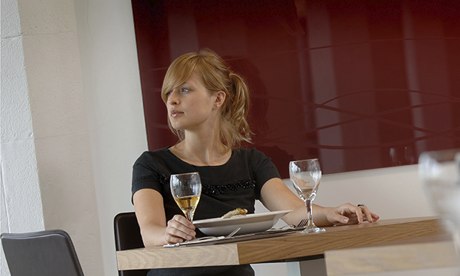
Even though around a third of us live alone these days, the image of the lone diner is still quite sad. Think Bridget Jones eating pickle straight from the jar with a spoon, or the business traveller on a table for two with only an iPad, or worse, paperwork, for company. It's not exactly aspirational.
Aside from the perceived tragedy of the lonely diner, it's not easy cooking for one either. Unless you're super-organised and cook in batches to eat at leisure, making food or ordering in for one person can be quite wasteful.
But the opportunity presented by the number of people who live (and, by implication, eat) alone is an entrepreneur's dream. Social designers, restaurateurs, and app-builders have been busy finding creative ways to tackle lack of dinner partners, wasted leftovers, and even how single eaters are perceived by culture. Could these make eating for one more palatable?

Tables for one

It might be that you're loud and proud about eating out alone. Taking the shame out of the experience is the idea behind Eenmaal in Amsterdam, a recurrent pop-up restaurant, with only tables for one. While communal tables make it easy to eat a meal alone without looking like you've been stood up by your date and help restaurants to save a cover on a table for two, they don't tackle the perception that eating alone is weird or uncomfortable. Creator, social designer Marina Van Goor, doesn't think it's either of those things. "If you sit at a communal table you're expected to chat and talk, and I wanted people to have the choice to do so or not. Through EENMAAL I wanted to break the perception that eating out alone isn't very attractive. Solitary dining can actually be an inspiring experience, because you get a chance to disconnect for a while in our hyper-connected world."

Global supper clubs

If you do prefer your food with company, the still-trendy supper club movement lends itself perfectly, since the intention is to share good food with interesting strangers. Finding a supper club in a strange city when you're away with work can be easier said than done, however. So, after being scooped up by a Greek local and taken home for dinner while travelling, Guy Michlin set up EatWith. It's a global supper club listing site, a little like the food version of AirB&B, where locals can invite travellers to tea. The site has 400 dinner hosts in 23 different countries who offer a homecooked-from-scratch meal for a fee. Guests register to join them for food and get a taste of local culture as well as local cooking. "Food is a wonderful way to create stronger connections between people," says Michlin. "This is exactly what we're doing and why the EatWith movement is proving so popular across the world."

Feeding your neighbours

Still, spending an evening with strangers isn't everyone's cup of tea. Some of us would actually prefer to dine alone and at home, but don't want to cook for one. If that's you, there's shareyourmeal.co.uk. Working from the premise that it's cheaper and easier to make food in bulk rather than in single person portion sizes, a group of neighbours in Utrecht in the Netherlands set up a WhatsApp group where they could share food if they cooked too much. From humble beginnings it's grown into a Europe-wide meal-sharing site.
Lovers of ladling out huge portions get to satisfy their urge to feed people by advertising what they're cooking. If you're nearby, you simply ask to have a portion, and go round with a container to collect it like takeaway. It's more inspiring than the singleton diet of late-night bowls of cereal, omelettes, and pasta-pesto (or is that just me?), and less wasteful than filling your fridge with food that will rot because you can't eat it all in time.

Meal sharing

But why would you buy food from your neighbour when you can just phone for pizza and have it delivered, you might ask? Unless you have a voracious appetite, even takeaway isn't really geared towards the lone eater. But now there's an app for that. Leftoverswap allows you to offer your uneaten takeaway to your neighbours for a small charge. After all, as their website says, '99% of us don't need a second helping of beef lo mein'. As long as you're not too squeamish about eating other people's cast-offs, it's one way to treat yourself on Friday night when you can't afford a full-blown takeaway. It minimises your food waste, and you get to feel good about sharing with your neighbours.
Are these good ideas? Could they help make the way all of us eat less wasteful, single or not? Or do they isolate singletons further from the joys of conviviality and communal eating?

http://www.theguardian.com/lifeandstyle/wordofmouth/2013/dec/18/eating-alone-no-shame-lone-diner-table-takeaway

Wednesday, 18 December 2013

How to eat: Christmas dinner

Ditch the turkey, the cranberry sauce and the Christmas pudding … has Tony Naylor taken leave of his senses? This is his take on the perfect Christmas dinner – how do you eat yours?
Christmas dinner
Christmas dinner: sprouts good, turkey bad. Photograph: Alamy
Deck the halls with Blu-tacked tinsel! Hark to the sound of melting credit cards! Yes, it's what we're contractually obliged, by Noddy Holder, to refer to as Chriiiiiisssstttttmmmmmaaaaaas. Which, with a kind of dread inevitably, means that How to Eat is tackling Christmas dinner. Yes, the Word of Mouth series trying to establish the ideal forms of Britain's favourite dishes is going deep on turkey and its assorted trimmings. Below the line, please remember that this is the season of goodwill, which even includes those fools who love cranberry sauce. Yes, even them.

Meat

Turkey? Schmurkey! I've eaten organic bronze turkeys reared exclusively on truffles and Classic FM in free-roaming paddocks that look like the 13th fairway at St Andrews, and you know what? They taste OK. A gazillion times better than your average frozen high-street bird, but just OK. And this for something that costs 12 quid a kilo, and which the average home cook – on the sherry since 10am – could easily incinerate.
What are the alternatives? Not goose (too much of a divisive gamey, livery twang); not duck (it's duck); not partridge (Asda was all out); and not pork (ordinary Sunday lunch fodder). No, you want rib of beef. Wing rib is marginally cheaper than a posh turkey; prime rib is the ultimate. Whatever beef you can afford will offer a bigger bang for your buck than bland, boring turkey.

Trimmings

Of course, that's the theory. But most people won't eat beef this year, because most people have no say in the matter. What's that? Take control, you say? Buy Mum The Female Eunuch and tell her to put her feet up? Perhaps you are cold enough to withstand that look of bereavement in her eyes across the dinner table. I find it easier to put up with her turkey crown and limp carrots.
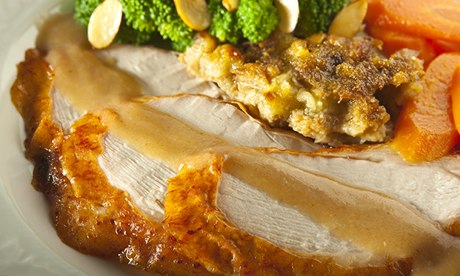
So, with turkey you need sprouts (small ones, shredded and fried with bacon); glazed carrots; roast potatoes and parsnips. All sorts of things make a nice addition, particularly creamy things such as cauliflower gratin or dauphinoise, and there many, many other things, from red cabbage to mangetout, that have no role to play whatsoever. However, those four vegetables are your core. Cook them diligently and you have the perfect vegetal yin to the real yang of the show: the pigs in blankets.
Christmas dinner is really all about the chipolatas and the stuffing. Your stuffing must have a sausagemeat base and it must be savoury. Chucking fruits and spices into the Christmas dinner mix is a bizarre historical hangover. Pork, sage and shallot, or chestnut and pancetta? They're stuffings. Apples, dates, apricot, ginger, prunes, cognac? They're masochistic.

Gravy and condiments

Gravy? Definitely. Otherwise that's one dry meal. Running out of gravy is a cardinal Christmas sin, second only to running out of booze. Condiments? Verboten! Theoretically, you could make a cranberry sauce that, spiked with orange and used sparingly, would provide a sharp counterpoint. But you won't. At the last minute, you'll grab a jar of something sickeningly sweet at the supermarket, better suited to a sponge cake. That's how they make £36bn out of us each Christmas. As for bread sauce, what is this? 1623? Made badly, it's like regurgitated rusk. Made properly, heady with cloves and nutmeg, it is another of those strange medieval flavours that has no place in the modern Christmas dinner.

Starters and dessert

To begin, something light that can be readied in advance: smoked salmon, pâté, soup. If you want to be flash, a zippy salad of dressed winter vegetables. The average Brit consumes 6,000 calories on Christmas Day. If you're looking to cut anywhere (and you'll have to prise that seventh Thornbridge Jaipur out of my cold, dead hand), cut Christmas pudding. That great, claggy lump of booze-sodden raisins is an endurance test. If you need a showstopper, one word: trifle. Better still, as your guests will be fit to burst, offer them cool, aerated relief – a bowl of ice cream.

When

3pm. It leaves just enough time for the nausea (from eating a selection box before 10.30am, topped up with three pints and a double brandy in the pub at midday) to subside, without interfering with the important business of the day – Corrie and EastEnders. Yet it still allows you to squeeze in a Christmas sandwich at about 10pm. This should include leftover turkey (look, it's been cooked, someone needs to eat it), ham, strong hard cheese and a little of that beer chutney someone thought was a better gift than actual beer (it wasn't).

A word on crackers

We're all suckers for the childish pleasure of pulling a cracker. And you can put that hat on for 10 minutes, if only to keep the peace. It won't kill you. But, please, do not spend big on upmarket crackers, hazardous candles, plastic yule logs and other overpriced table decoration tat. This year, Waitrose is selling six crackers for £40. No, that isn't a typo. As Robin Williams said of cocaine, when you're spending 40 quid on Christmas crackers, that's God's way of telling you you've got too much money.
So, Christmas dinner: how do you eat yours?

http://www.theguardian.com/lifeandstyle/wordofmouth/2013/dec/18/how-to-eat-christmas-dinner

Text Widget

Blog Archive

Contact Form

Name

Email *

Message *

© 2014 Fashion. WP Wildweblab converted by Bloggertheme9